
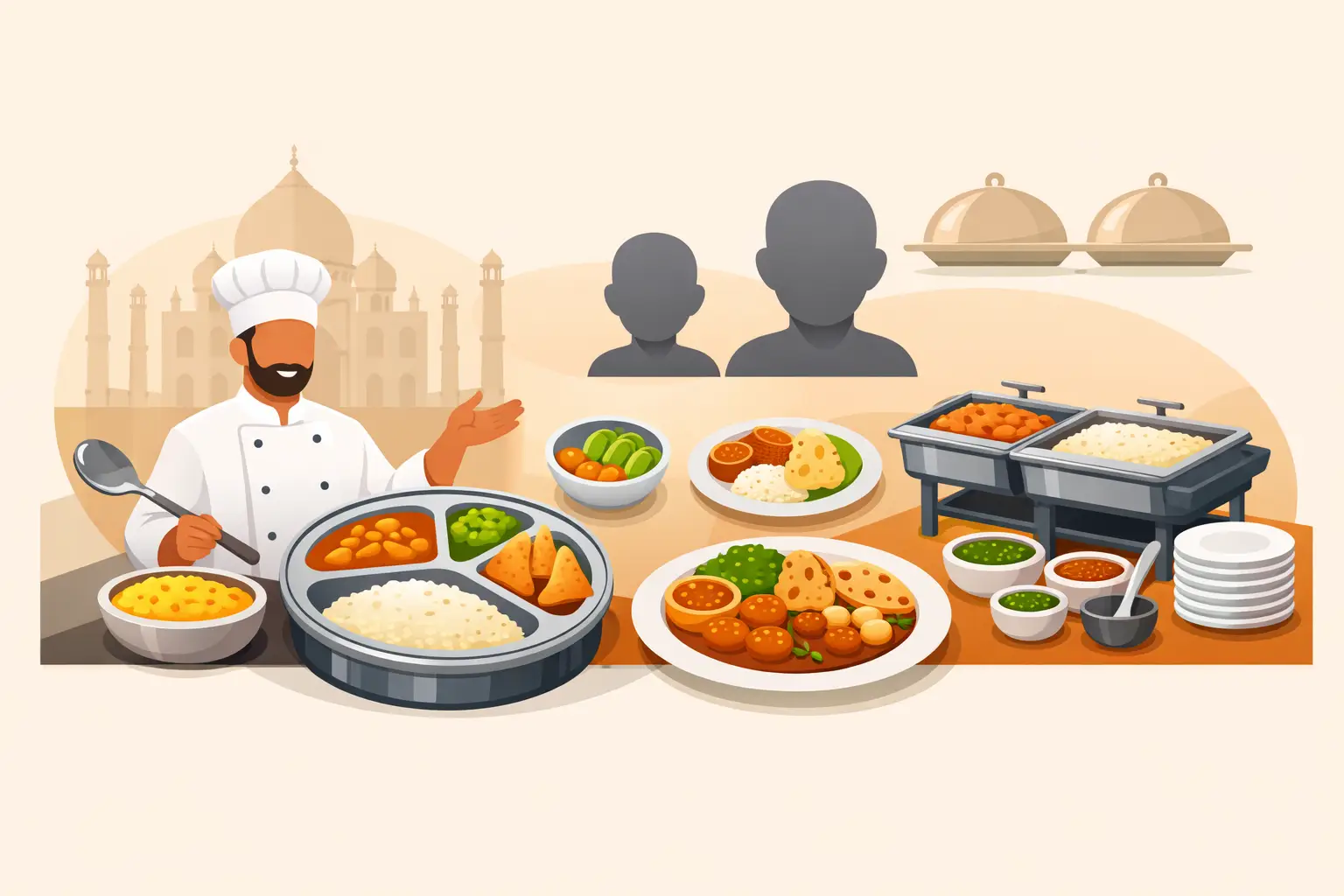
A catering order can look generous on paper and still run short when the first naan basket is empty. Equally, ordering every favourite dish in large quantities can leave a host with far more food than guests can enjoy. This guide to Indian catering portions helps you plan a satisfying spread for Queensland gatherings, with enough variety for the table and sensible quantities for the occasion.
Indian food is made for sharing. Curries, fragrant rice, tandoori dishes and fresh breads give guests choices, while vegetarian and vegan dishes make it easier to cater for a mixed group. The key is not simply ordering more food. It is matching the menu and quantity to your guest list, the time of day and the way people will eat.
Start with the event, not the menu
Before choosing dishes, confirm the number of guests who are likely to attend rather than the number invited. For a casual birthday, community function or family celebration, it is wise to allow a small margin of around 5 to 10 per cent if numbers are uncertain. For a formal seated meal with confirmed guests, you can order closer to the final headcount.
Then consider whether catering is the main meal. A weekday office lunch usually calls for straightforward, filling portions with rice and bread. An evening celebration that begins with drinks and canapés may need fewer mains but a more generous selection of starters. A long event can encourage guests to return for another plate, particularly if food remains available later in the evening.
Guest mix matters as much as total numbers. Ask in advance about vegetarian, vegan and dietary requirements, and consider children separately. Children often eat less overall, though rice, mild curries and naan tend to be popular. If your group includes many big eaters, teenagers or guests travelling a distance to the event, build in a little more rice, bread and substantial main dishes.
Guide to Indian catering portions for a main meal
For a buffet-style Indian meal, plan around a balanced plate rather than treating each dish as a complete individual serving. Most adults will take a portion of curry, rice, bread and perhaps a starter, then come back for more of what they enjoy.
As a useful starting point, allow around 180 to 220 grams of curry per adult when there are two or more curries available. This is the combined amount across the menu, not the amount of each curry per person. For example, if you serve butter chicken alongside a vegetable curry, guests will usually take a little of both. Where there is only one curry, increase the allowance to around 250 grams per adult.
Rice is the foundation of many Indian catering orders. Allow around 180 to 220 grams of cooked rice per adult as part of a buffet meal. If biryani is the main centrepiece rather than a side dish, allow closer to 250 to 300 grams per adult. Biryani is more substantial than plain basmati rice, especially when it includes meat or vegetables, so it can reduce the amount of curry and bread required.
For naan, a practical guide is three-quarters to one naan per adult when rice is also served. At a relaxed family dinner, or where guests particularly enjoy bread with curry, one to one-and-a-half naan per person may be more suitable. If you offer roti as well as naan, divide the bread quantity across both rather than ordering full portions of each.
A simple example for 20 guests
For 20 adults eating a full buffet meal, a well-balanced order might include two to three curries totalling roughly 4 to 4.5 kilograms, about 4 kilograms of cooked rice or a mix of rice and biryani, and 18 to 24 naan. Add a vegetable side or dal, plus starters if the event calls for them.
This is a guide, not a fixed rule. A menu centred on rich, creamy curries and biryani will satisfy guests differently from a lighter menu of tandoori items, salads and bread. The more dishes on the table, the smaller each individual serving needs to be.
Choose variety without over-ordering
A generous menu does not need a separate dish for every preference. For a group of 10 to 20 guests, two curries often work well: one non-vegetarian option and one vegetarian or vegan option. For 25 to 40 guests, three curries provide a better balance, such as a chicken curry, lamb or beef dish, and a vegetable or lentil dish.
For larger groups, variety becomes more useful because guests will have different tastes and dietary needs. Even then, keep the menu focused. Four main dishes, rice, breads and one or two starters will usually feel more complete than a crowded selection of small trays.
A vegetarian dish should not be treated as an afterthought. Dishes such as dhal, chickpea curry, mixed vegetables or paneer can be enjoyed by everyone and help balance richer meat curries. If you know several guests are vegetarian or vegan, make sure there is enough of the suitable option for them to have a full meal, not just a small side serving.
Plan starters according to timing
Starters are most useful when guests will be waiting before the main meal, or when the event has a casual, social format. For pre-dinner snacks, allow two pieces per person if the main meal follows soon after. For a drinks reception or function where starters are expected to carry the first part of the event, allow three to four pieces per person.
Tandoori platters, samosas, onion bhajis and other shareable items are popular choices, but they should complement rather than replace the main meal unless you are planning a cocktail-style event. If you offer several starter types, guests will naturally sample each one, so modest quantities across the range are usually enough.
Be mindful of spice levels as well. A mix of mild and medium dishes helps a wider group enjoy the meal, particularly when children, work colleagues or guests unfamiliar with Indian cuisine are attending. A little variety in heat is more welcoming than making every dish very spicy.
What changes the portion size?
Portion planning depends on the details. Lunch events often need less food than evening functions, while buffet service generally needs a little more allowance than plated service because guests choose their own portions. Alcohol can increase appetite and encourage guests to stay longer, so evening celebrations may benefit from extra starters and bread.
Weather can also play a part. A warm Queensland afternoon may favour lighter quantities and refreshing accompaniments, whereas a cool evening can see guests reach for more curry, rice and naan. If there are other substantial foods at the event, such as dessert, grazing platters or a barbecue, reduce the main catering order accordingly.
Takeaway containers are another consideration. Leftovers are not always a problem, especially for a family event where guests are happy to take food home. However, the aim should be a comfortable surplus, not trays of food that cannot be stored or shared safely. Ordering a little extra rice and bread is often a better safety net than doubling up on every curry.
Make ordering easier for your group
When placing a catering enquiry, provide the guest number, event time, whether food is lunch or dinner, and any dietary requirements. Mention if you expect mostly adults, families with children, or a group with several vegetarians and vegans. These details make it much easier to recommend quantities that suit the occasion.
It also helps to decide how food will be served. A buffet needs serving spoons, plates and a clear order for the table so guests can move through easily. Put rice and breads close to the curries, and make dietary dishes clearly identifiable. If food will be delivered before guests arrive, allow time to set it out while it is still hot and appealing.
For a relaxed gathering, food should feel abundant, familiar and easy to share. Begin with realistic guest numbers, choose a balanced mix of dishes, and leave room for people to enjoy the flavours they know and love. A thoughtful order gives every guest a good plate of food and lets the host spend more time with the people who came to celebrate.